
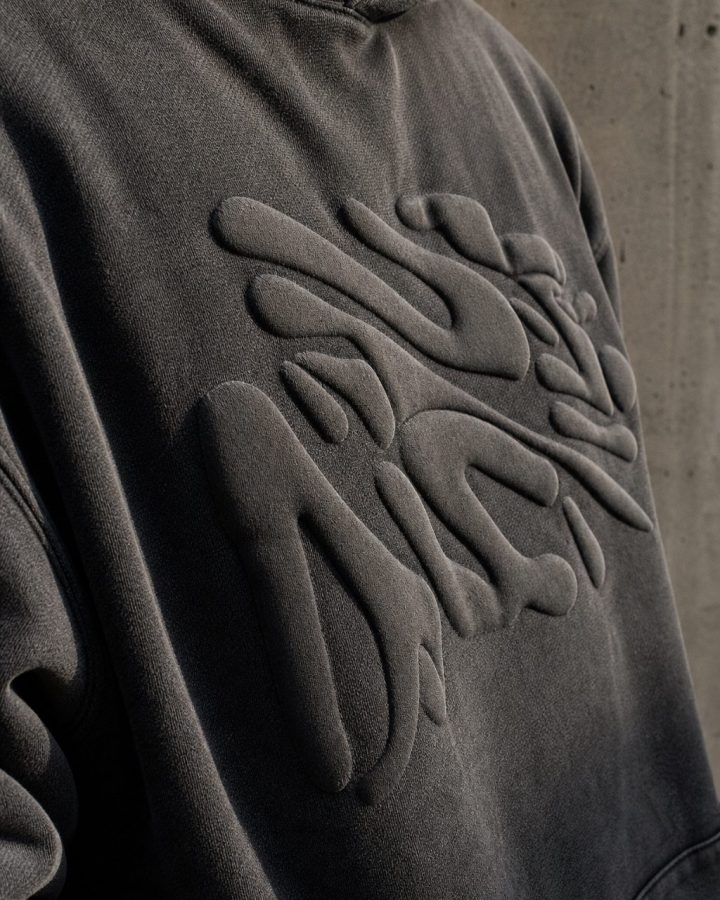
Similarly, for hoodies, the surface craftsmanship determines their feel, price, and durability. The following six methods are the most commonly used for street lines, each with clear applicable boundaries.
Acid washing: creating uneven fading on finished garments, with each piece having a different texture. The darker the background color, the more obvious the contrast, and the overall style leans towards American retro and 90s street style. It belongs to the water washing process, and slight color difference in the same batch is a normal phenomenon. Before placing an order, the color sample should be confirmed first.
Puff printing: Adding foaming agent to the paste, the pattern is three-dimensional raised after high-temperature curing, and fingers can feel the obvious height. Suitable for large characters and local embellishments on the chest. The finer the pattern, the more difficult it is to achieve a three-dimensional effect, and extremely fine lines and tiny text are not suitable for puff printing.
Screen printing: One color version, color by color scratch printing. The lowest cost and best color fastness are achieved when using single or few colors, making it suitable for stable and repetitive production of large quantities; The more colors there are, the higher the cost. Gradient colors and photo quality images are not suitable for screen printing.
Digital printing: The pattern can be directly printed without the need for typesetting, and the number of colors hardly affects the cost. Suitable for full frame printing, gradient colors, and photo level details, as well as small batches of multiple items in small quantities. The disadvantage is that the pricing is based on the area, and the bulk quantity is usually higher than screen printing. Dark fabrics need to be coated first before they can show color.
Hot stamping: Use hot pressing to fix the drill on the fabric, forming dense highlights under light. Mostly used for local patterns, letters, and edge decorations. The firmness depends on the temperature, pressure, and time of hot pressing; It is recommended to use less water in areas with frequent washing and friction.
Embroidering with old fabric: Stitching the fabric onto the garment body and then stacking dense embroidery threads, deliberately preserving the edges and corners with rough edges and broken lines. The layering and texture are stronger than ordinary flat embroidery, but the more layers stacked, the thicker and heavier it becomes, and the higher the requirement for pattern accuracy. The cost is higher than ordinary cloth embroidery.
The logic of choosing one sentence: to be durable, choose screen printing; to be flexible, choose digital printing; to be premium, choose pickling and aging; to be recognizable, choose puff printing and hot stamping.